|
1.0
Traffic Accident - What To Do Next?
- Be calm and do not panic.
- If there are injuries to any persons, call 999 for assistance.
- If there are no injuries, move your vehicle to a safe area
away from traffic, where possible.
- Note the names and addresses of the other driver(s) involved.
- Note the model and vehicle registration number of
the vehicle(s) involved.
- Note names and addresses of witnesses, if any.
- Sketch a simple diagram of the accident scene and
the position of each vehicle right before and after the
accident (Photos of the accident scene, if available,
can be very helpful).
- Exchange information on the names of your respective
insurance companies/takaful operators.
- Do not discuss on whose fault it was. This may complicate
the handling of your claims.
- If your vehicle needs to be towed, ensure that the vehicle
will be sent to the correct workshop. Call your insurance
company/takaful operator or its accident hotline number
for the appropriate workshop.
- Report the accident to the police promptly.
- Inform your insurance company/takaful operator promptly
even if you do not intend to make a claim. The third party
involved in the accident may make a claim against your
insurance company/takaful operator which would cause
you to lose your NCD.
- Complete the claims form in full and include any
additional relevant information. If in doubt, ask your insurance company/takaful operator for advice.
. back
to top
2.0 How To Prevent Your Vehicle From Being Stolen?
2.1 Secure your Vehicle
- Lock your Vehicle .
- Never Leave the vehicle key inside the vehicle unattended.
- Never leave your vehicle's engine running, even if you will
only be away for a minute. Vehicles are commonly stolen at
convenience stores, petrol stations, ATMs and outside house
compounds when owners leave the vehicle engine running
to run errands or to unlock house gates.
- Ensure your vehicle windows are properly closed up.
- Do not leave valuables in your vehicle. However, if you have
to, place valuables out of sight in the boot. Ensure that no
one sees you placing valuables in the boot.
back
to top
2.2 Parking
- Park in well-lit areas - vehicle theft usually occur at night
under the cover of darkness.
- Park in attended lots - vehicle thieves do not like witnesses
and prefer unattended parking lots.
- Park your vehicle in the compound of your house rather
than outside. Lock both your vehicle and the gate for
improved security.
back
to top
2.3 Security
- Professional thieves are able to steal any vehicle.' However,
you can make it difficult for them to steal your vericle.
The more layers of protection on your vehicle, the more
difficult it is to steal.
- Your budget and personal preferences should determine
how many layers of protection and which anti-theft
devices are best for you.
-
Generally available anti-theft devices are:
- Engine immobilizers
- Better door and ignition locks.
- Security patterned or coded keys
- Radio/CD players with security code or removable
face plates
- Window etching
- Car alarm
- Steering wheel/gear/brake pedal locks
- Tracking devices
back
to top
3.0 Private Car - Coverage for each type of cover.
| Types
Cover |
Third party Cover |
Third party, fire
& theft cover |
Comprehensive
Cover |
Liabilities to third
party for:
. injury
. death
. property
loss/damage |
|
|
|
Loss/damage
to own vehicle
due to accidental
fire/theft
|
|
|
|
Loss/damage
to own vehicle due to accident
|
|
|
|
Liabilities to
driver &
passengers
of own vehicle
(property, bodily
injury, death)
|
|
|
|
Exclusions
Your standard motor insurance policy DOES NOT cover:
- Your own death or bodily injury;
- Your liability against claims from your passengers;
- Theft of non-factory fitted vehicle accessories (car stereos,
leather seats, sports rim, etc.) unless otherwise declared.
- Consequential loss, depreciation, wear and tear,
mechanical or electrical breakdown failures or
breakages; and
- Loss/damage arising from an act of nature e.g.
flood, landslide.
However, you may pay additional premiums to cover some of
the above exclusions e.g. flood or your liability against claims
from your passengers. Windscreen and vehicle accessories
covers are also useful extensions to consider for preserving
your No-Claim-Discount (NCD) in the event of a loss/damage.
Please check for other exclusions and extension covers available with your insurance company/agent.
back
to top 4.0
What should you know when buying motor insurance cover
4.1 Insurable interest
Make sure that you buy cover as soon as you purchase a vehicle.
If you buy a used car, you should protect your interest by
purchasing a motor insurance cover as the cover of the previous
owner is no longer valid even if legal ownership transfer has not
been effected with Jabatan Pengangkutan Jalan (JPJ).
back
to top
4.2 Insured Value / Sum Insured
Ensure your vehicle is adequately insured.
New vehicle: sum insured = purchase price.
Others: sum insured = market value of vehicle when policy
is bought.
Under-insurance: if sum insured is less than the market value, you are deemed as self-insuring the difference. In the event
of a loss, you will only be partially compensated.
Over-insurance: if sum insured is higher than market value, maximum compensation is the market value of the vehicle.
You cannot profit from a claim (principle of indemnity).
Determination of market value of your vehicle
is important to avoid under- or over-insurance.
back
to top
4.3 Average Clause
It is applied when you suffer damage to your vehicle which
is under-insured. Your claim will be reduced proportionately
by the uninsured portion, e.g. if you have insured your vehicle
up to 70% of the market value, the insurance company will
only pay 70% of the total repair cost.
back
to top
4.4 Disclosure
Disclose all material facts, e.g. any previous accidents
and modification to engines. If you fail to do so, your
insurance company may refuse your claim or any claim
made by a third party against you. In such cases, you
are personally liable for those claims.
back
to top
4.5 No-Claim-Discount
The premium payable may be reduced by your NCD
entitlement. NCD is 'awarded' if no claim was made
against your policy during the preceding 12 months
of policy. Your NCD entitlement will depend on the
class of your vehicle and number of years of continuous
driving experience without any claim made against
your insurance policy. You will lose your entire NCD
entitlement once an own damage or a third party
claim is made against your policy.
back
to top
4.6 Excess
It is the amount of loss you have to bear while your insurance
company will pay for the balance of your vehicle damage
claim. If you have an 'excess' on your policy, you must pay
the amount of the 'excess' direct to the repairer.
back
to top
4.7 Payment of Premium
- Premium must be made to the agent representing your
insurance company or to your insurance company directly
before cover can be granted.
- Payment can be made by cash, credit card or cheques
(cheques should be made payable only in the name of
the insurance company).
- Insist on a receipt for the premium paid to your insurance
agent or insurance company.
- With the full implementation of the JPJ elNSURANS
system with effect from 2 January 2005, physical cover
notes are no longer issued. However, a statement
containing details of your motor cover will be issued to
you as confirmation of purchase of motor insurance.
- Through the JPJ eINSURANS, all information on insurance
coverage will be channelled electronically by your agent!
insurance company to JPJ.
- Contact the insurance company if you have not received
the insurance policy after one month of purchase.
back
to top
5.0 What you should know when making a claim?
If your car is involved in an accident:
- Take note of the names and addresses of all drivers
involved, make/model and registration numbers of
each vehicle, the drivers' licence numbers, the insurance
particulars and names and addresses of witnesses.
- Make a police report within 24 hours and immediately
notify your insurance company in writing with full
details.
- If your vehicle is damaged, you may either make an own
damage claim or a third party claim:
Own damage claim - making a claim against your own comprehensive policy. However, you will lose your NCD entitlement.
Third party claim - if you are not at fault in the accident, you can submit the claim either directly
to the insurance company of the party at fault,
or if you have a comprehensive policy, to your
insurance company, without losing your NCD
entitlement. You are encouraged to submit
your claim to your own insurance company
for speedier claims processing.
- For own damage claims, call your insurance company
immediately for advice. If your insurance company
recommends or requires that repairs be done at a panel/
authorised workshop, then take your vehicle there as
advised. Your insurance company will reject your claim
if your vehicle is sent to a workshop that is not authorised
by your insurance company. Your insurance company will
send an insurance 1055 adjuster to assess the damage to
your vehicle before authorising the repairs.
back to top
5.1 Betterment
It is applied when in the course of repairing an accident-
damaged vehicle (age of vehicle is five years and above),
an old part is replaced with a new franchise part. You will
have to bear the difference in cost (depending on the
age of your vehicle) as your repaired vehicle is in a better
condition than it was before the accident.
back to top
5.2 Compensation for Assessed Repair Time (CART)
- CART means a reasonable amount payable by third
party insurance companies as compensation for 1055
of use of vehicle.
- You can only claim for CART if you are not the party
at fault in the accident.
- The number of days allowed for CART is based on
insurance 1055 adjuster's recommendation on the
number of working days estimated to repair the
accident-damaged vehicle and not the number of
days the accident-damaged vehicle is at the workshop.
- Where receipts are produced for vehicle rentals (only
from a licensed car rental company), insurance
companies shall pay the amount shown on the receipt
and original car rental agreement, subject to the condition
that the vehicle rented is of an equivalent model to that
of the damaged vehicle. The number of days allowed is
based on the insurance 1055 adjuster's recommendation
on the number of working days estimated to repair the
accident-damaged vehicle.
back to top
6.0
How to lodge a complaint and redress avenues available?
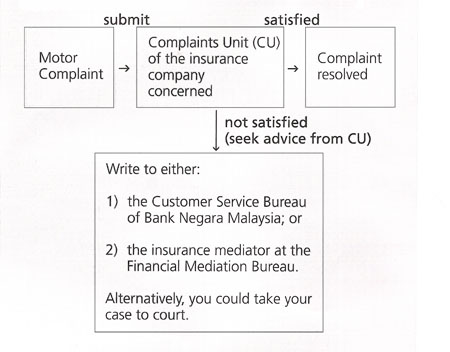
back
to top
|









 or
or 

